



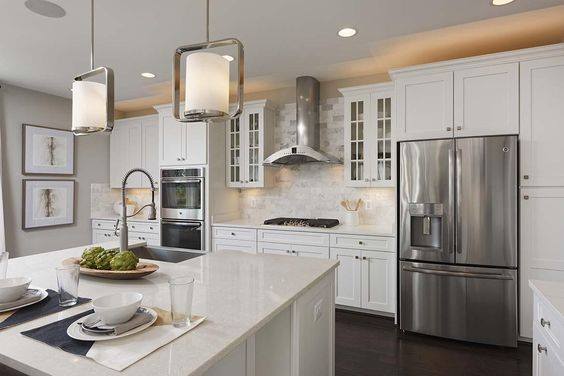

A new kitchen is a huge but worthwhile investment for any home. Looks and functionality wise, it will always add value to your property. But there are key kitchen design mistakes to avoid to ensure it doesn’t cost you in the long run. One thing you don’t want to do is forget the finer details.
So often it’s the most obvious things that we simply forget when thinking about designing or reconfiguring kitchen layouts – such as where the bins go or how accessible the fridge is when you’re cooking.
The primary function of any kitchen ideas is to cook and prepare food, so it has to be highly functional. It’s therefore important to always start the design process by looking at how you use the space when preparing and cooking meals.
21 Common kitchen design mistakes to avoid
‘It can be easy to get carried away in the creative design process, but it’s important to take a step back at the beginning and think about what you need in your kitchen,’ advises Andy Briggs, Interior Designer at Optiplan Kitchens.
‘Do you need space for a big family table or a double oven for those weekly Sunday roasts? Or have the children now moved out, and a breakfast bar is all you need? If you are planning a large kitchen renovation, think about whether the space works for you or if you need to knock down a wall or plan an extension.’
Thanks to innovative design, from space-maximising U-shaped kitchen ideas to multipurpose islands, these days our kitchens can be the best-dressed room in the house. We’ve compiled a list of what not to do when designing the kitchen of your dreams.
1. Breaking the flow
Image credit: Future PLC
Always think first and foremost about how the kitchen layout will flow – this is the key to any design success. The working kitchen triangle is the classic rule of design, where the flow of the kitchen is based around the ‘triangle’ shaped area made by the positioning of the sink, cooker, and fridge. The triangle is the journey from one to the other, which determines how best to lay out a kitchen, based on the flow. But with modern kitchens working harder than ever, it goes beyond the principle of the age-old triangle.
‘The kitchen has now become a multipurpose room that continues to develop in style, function, and layout,’ says Simon Bodsworth, Managing Director, Daval. ‘So you can no longer assume that it will only have three work areas as the traditional work triangle suggests.’ Adapt the working principle to suit your needs, ensuring the flow is seamless throughout.
‘A good kitchen workflow is essential. If you don’t have one, your kitchen won’t work as well as you need it to. In the planning stages, people can focus on the aesthetics too early in the process’ says Andy Briggs, Interior Designer at Optiplan Kitchens. ‘The number one priority should be functionality. If it looks nice but doesn’t work, then it will soon become a nuisance and only create stress instead of enjoyment.’
2. Mis-measuring worktops
Image credit: Optiplan Kitchens
Securing worktops at the wrong height can jeopardise the entire functionality of a kitchen design. So is there a rule for determining the correct height for a worktop? We ask the expert Andy Briggs, Interior Designer at Optiplan Kitchens, who says: ‘On average, kitchen worktops are between 890 and 940mm high. This gives the most comfortable height for carrying out common kitchen tasks.’
‘However, there is no perfect height for worktops as worktop thicknesses and plinth heights usually govern this. These two items can vary depending on either your supplier or your own personal preference.’
3. Laying inadequate flooring
Image credit: Carpetright; Premoda Ruscello, Rhone Oak laminate, £46.99 m2
The wrong flooring is a critical and costly kitchen design mistake to make. ‘In kitchens, there are three main things to consider: safety, durability, and ease of cleaning,’ advises David Snazel, Buyer of Hard Flooring at Carpetright. ‘Kitchens usually see a lot of traffic, so it’s best to opt for high-quality, durable flooring that is low maintenance and will stand the test of time.’
Hard flooring styles, such as vinyl and laminate, are a durable and cost-effective solution for kitchens; each has its specific features and benefits. Before selecting a type of kitchen flooring, first take the time to consider the space you are looking to update to avoid mistakes. This will help determine suitability and style.
‘Before purchasing, it’s important to look at the details and whether it is replicating your desired flooring style’s elements. It’s worth visiting a store or ordering samples to ensure you can view each finish and ensure it is in keeping with the rest of your decor and the look you are trying to achieve.’
4. Working with the wrong paint
Image credit: Dulux
While colour is key when it comes to kitchen paints, it’s more about the finish, because if you get that wrong, the paint won’t last – no matter how glorious the shade is, it will quickly be ruined by splashes and spills. A kitchen paint needs to be more durable than your average matt emulsion finish.
‘Kitchens are arguably the hardest working rooms in our homes, and so you need a paint that has been designed to work just as hard,’ says Marianne Shillingford, Dulux Creative Director. ‘Standard emulsion paints can begin to look tired very quickly on kitchen walls, and so you need to look for something that has been specially formulated in a beautiful matt finish that is hard-wearing, grease resistant, and washable, just like Dulux EasyCare kitchen paint.’
‘If you are painting the units as well as the walls, choose Dulux Quick Drying Satinwood, Eggshell or Gloss finish. And use a primer designed for difficult surfaces so your paint doesn’t chip or scratch off easily. The quick drying property will allow you to get the job done twice as fast, and because it’s water-based, there are no nasty solvent fumes you have to live with, plus it’s much kinder to the environment.’
5. Misjudging door clearance
Image credit: Future PLC/ David Giles
It feels simple enough to factor in, but it’s an easy kitchen design mistake to make – misplacing door layouts so they can’t be opened fully, or opened at the same time, is a kitchen nightmare. Ensure thoughtful planning when placing cupboards and doors.
‘A lack of planning can lead to endless issues in fitting, as well as when you come to use it. This can impact the simplest of things like the ability to open cabinets and/or appliances’ says Andy Briggs, Interior Designer at Optiplan Kitchens. ‘This may seem nonsensical, but the opening ‘swing’ of a door is sometimes overlooked and can lead to endless headaches and alterations in the middle of the fit. Is there enough space to stand when you open your tall fridge/freezer, or will my wall unit open if I choose to have feature pendant lights?’.
‘Failing to allow enough space to breathe can make any kitchen feel cramped and restricted – something which you need to avoid at all costs, where possible. To provide the minimum circulation between cabinets, try to have at least 1.2m of space between kitchen units (i.e. between walls and island units). You should also try to allow a little more room if the kitchen is a thoroughfare, like a galley.’
6. Cutting corners
Image credit: Magnet
All good kitchen designs make the most of corners, using every inch of space available makes even the smallest of spaces more functional. Choose a clever small kitchen storage idea, such as a corner unit, to maximise storage potential. A corner unit is designed to pull out and provide extra storage that reaches into the depths of wasted space, which lies within corners.
7. Forgoing splashbacks or upstands
Image credit: Future PLC
A common and easy kitchen design mistake to make is to leave walls unprotected. Kitchen walls need all the help they can get to protect against everyday life. Areas behind the cooker and sink especially need a layer of protection to ensure watermarks and spills don’t ruin the paintwork.
Whether you opt for a full splashback idea or a slight upstand, choose a protective layer to suit your kitchen design. Even when you have tiles, it pays to add a dedicated protective layer – to save the grout from discoloring.
8. Contemplating cupboards as the only solution
Image credit: Future PLC
Kitchen cabinets are not the only solution when it comes to storage, especially if you’re working on a budget. ‘It’s true that when it comes to designing and planning your new kitchen, the cabinets can be a large chunk of the cost. If you’re trying to stay within a strict budget, try opting for open shelving on higher levels, rather than wall cabinets’ explains Optiplan Kitchens’ Interior Designer, Andy Briggs. ‘This will allow you to store everything from mugs and glasses to cookbooks, and also enables you to display stylish accessories and family photos – creating that ‘heart of the home’ feeling in your kitchen space.’
9. Overlooking a heating element
Image credit: The Radiator Company
Who’d have thought heating features would be kitchen design mistakes to avoid? There’s the danger of thinking that because of the oven, you already have a source of heat, so heating is not as important – but the oven is not on all the time, right? Plus, if your space is open-plan, there’s a lifestyle element to the space that needs to feel warm and inviting, not cold and uncomfortably chilly.
‘Kitchens often have limited proportions but are some of the busiest places in our homes,’ says Simon Morris, Marketing Manager at The Radiator Company. ‘We need the space to look and feel comfortable, but also ask a lot from them. A bit of thoughtful planning can help the space feel more elegant from a decorating standpoint, but it’s also worth considering how we can also make our kitchens work harder from a practical perspective.’
‘Whilst many homes opt for a towel rail to heat the kitchen from a multi-functional approach, but they can be more than just practical and design-led. Using classic or contemporary designs and custom finishes to key in with your décor can make your heating fit in seamlessly.’
10. Forgetting counter space
Image credit: Magnet
When it comes to planning a kitchen, making the most of every inch of usable space is a must. A widespread mistake in kitchen design is not including enough counter space to work with.
‘Remember to include enough space to prepare meals, display all your appliances, wash up, and potentially space to eat and socialise if that is how you plan on using the kitchen,’ advises Hayley Simmons, Head of Merchandising for Magnet.
11. Underestimating how much storage you need
Image credit: B&Q
Plan accordingly and allocate a space for every single thing, from spice jars to cutlery-separating drawers. Although the temptation to keep adding to the list can be great, a clear initial index will keep you on track. By sticking to a clear plan, you also avoid the temptation to overcrowd your brand-new kitchen.
‘The key to getting the most storage out of your space is thinking of clever ways to integrate kitchen storage ideas and solutions into existing kitchen essentials,’ explains Iain McColgan at B&Q. ‘For example, magnetic panels help utilise unused wall space between wall and base cabinets.’
Thinking outside the box, again, he goes on to suggest: ‘For bulkier items, you should also consider pull-out corner storage. Designed to fit into the cabinets easily, pull-out storage helps efficiently store away items and makes them easy to access when needed.
‘Finally, don’t forget to utilise floor space by considering a trolley which creates extra space when you’re preparing food, or could even be used as a drinks trolley when entertaining.’ All worthwhile considerations when it comes to creating a kitchen that works its hardest to cater for all your needs.
12. Neglecting ventilation
Image credit: Optiplan Kitchens, Napoli collection in Metallic Blue. Prices start from £5,175
Good ventilation is key for any kitchen, especially in one where you’re cooking up delicious dishes day in day out. Cooking, especially on the hob, can leave lingering smells that if not ventilated can drift throughout the home. While the smell of home-cooked food is delicious in the moment, you don’t want the rest of the house to smell and ruin the atmosphere.
The experts at Optiplan Kitchens advise, ‘Invest in a proper ventilation system that is efficient at capturing impurities, circulates air, and, overall, keeps your kitchen clean. Avoid inexpensive products that merely recirculate air, as they consume a lot of energy. There’s always a solution that keeps the noise levels and energy use to a minimum.’
13. Allowing rubbish to pile
Image credit: Binopolis
It sounds undeniable, but when it comes to the rubbish, because it’s the least glamorous part, bins are often overlooked. One of the simplest but most common kitchen design mistakes. Given that waste is unavoidable, it should be factored in as a priority. Even more so given we now require separate recycling, food, and general waste disposal.
The best solution is integrated bins, or at least cupboards to conceal freestanding bins. Hiding not only the presence of waste, but also helping to contain odours. When the dedicated space isn’t allocated at the planning stage, the only viable option is a free-standing bin on display.
Thankfully, you can buy stylish solutions now. But if this wasn’t part of the plan, it won’t please you when you realise waste disposal has been overlooked.
14. Skimping on lighting
Image credit: Future PLC/ David Giles
Like most rooms, it’s essential to get the lighting right for the functional use as well as the aesthetic look. Prepping food will require more direct, brighter lighting than that of a dining area within the kitchen.
Bright kitchen lighting ideas, such as spotlights concealed under wall cabinets and in the ceiling, are still the most popular, practical choice to use throughout. They can be grouped according to tasks and used with dimmer switches so you can change the atmosphere in an instant.
You might also want to consider plinth lighting. Strips that run along the base of your cabinet can provide a subtle light that will illuminate your kitchen after hours. Handy if you should sneak in for a midnight snack!
For areas of the kitchen where family and friends gather, consider living-room style lighting. Pendants add a more focal light source and create ambience, as do table lamps on a sideboard. Overhead spotlights can be switched off or dimmed low when you want those statement lights to take the focus.
15. Avoiding expert advice
Image credit: Future PLC/ Darren Chung
Often, the temptation to DIY is so great that we forget the level of expertise involved in planning any major home project, especially with a kitchen where complicated wiring, plumbing, and ventilation systems all feature heavily. These are not to be messed with if you don’t know what you’re doing. Not seeking professional help can be one of the most costly kitchen design mistakes to make.
Seeking the help of registered tradespeople can lend a hand with planning and project management, too. You need to know when to carry out each stage of the work. There’s no point tiling until the electricians have been in, for example.
‘Looking at the bigger picture, a smart investment at the beginning of the project can prove to be more cost-effective in comparison to an amateur take on such a complex task,’ explain the experts at Optiplan Kitchens. ‘There’s no shame in getting some expert advice, especially when undertaking a massive project, such as a kitchen renovation.’
‘Complicated wiring, plumbing, or ventilation systems are not to be messed with unprofessionally. Plus, having a registered tradesperson to lend a helping hand can relieve the pressure of thinking about every single detail. Looking at the bigger picture, a smart investment at the beginning of the project can prove to be more cost-effective in comparison to an amateur take on such a complex task.’
16. Leaving out a power supply
Before you commit to plumbing in all your appliances, think about how you will use your kitchen, and get the power supplies in the right place. Think about your workflow within the space.
Where’s the tea point going to be? Is there another plug to hand for the toaster? Is the microwave integrated, or do you need to allocate worktop space for this bulky appliance?
17. Going over budget
Image credit: Magnet
Going over budget is one of the most common mistakes seen in many a home renovation. We’ve all seen enough Grand Designs episodes to know only too well that project costs can increase dramatically.
It’s often the forgotten factor, such as above, that can add to the inflated costs. The easiest way to avoid overspending is by creating an inventory list, ensuring it accounts for both furniture and contents.
‘Never start a kitchen renovation without a budget and plan in mind,’ says Hayley Simmons at Magnet. ‘Even if you have the money to splash out, having a set figure and keeping what you need from your renovation in mind can help avoid overspending.’ Avoid the temptation to keep adding to the list! A set, accurate budget from the beginning will keep you on track.
Hayley goes on to say, ‘Don’t spend money on unnecessary or impractical items that will wear easily and need to be replaced. For example, if you want a solid wood worktop, but cook a lot and have small children who could damage and stain it, a laminate wood effect worktop may be more cost-efficient and more durable for your needs.’
18. Not reworking the layout
Image credit: Future PLC/ David Giles
A new kitchen doesn’t mean you have to change the existing layout, if it ain’t broke, don’t fix it. You can replace like for like with new cabinets and accessories to refresh a space without having to rework the layout completely. Or simply reconfiguring an existing space can go a long way.
I have personally taken this approach in my kitchen, and as a result of extending the worktop along one wall rather than taking up two corners, the space feels as though it’s double the size. All the units were salvaged and refitted under a new length of worktop, meaning a low budget for a significant impact!
19. Poorly placed appliances
Image credit: Future PLC/ Chris Snook
A well-considered kitchen appliance layout idea will ensure a smoother-running kitchen. Forgetting to factor in electrical goods, at the point of design especially, will make for a less functional space.
20. Leaning towards style over substance
Image credit: Future PLC
When it comes to fixtures and fittings, it’s easy to be swayed by the hottest new designs that look fabulous, but don’t let your choice be more about style than practicality. For instance, in a family kitchen, the latest metallic designs might not be the most practical for sticky little fingers. The newest kitchen trends might not work for your home, and that’s ok – a kitchen has to be functional to be of value.
21. Choosing a design that will date
Image credit: Future PLC/ Keith Henderson
As tempting as it is to go for the latest trends, make your kitchen design a more considered choice. Avoid choosing a design that is likely to date and be old news in only a few years. Kitchens are not cheap to replace. Keep this in mind when designing your dream kitchen.
If you’re watching the pennies but don’t want to compromise on style, a great budget kitchen idea is to paint the cupboards yourself!
You can go all out there with the paint, wallpaper, and accessories, but these can be easily and affordably alternated if desired. Brightly coloured gloss cabinet doors that you can’t paint may seem like a great idea now, but will you love them a few years down the line? If you will, go for it! If you’re at all unsure, stick to a timeless and classic choice.
A good kitchen should see you through at least 10 years, so it’s essential to get it right. It’s worth thinking too about its resale value, especially if you plan on moving within 10 years.
Now that you’ve got a complete checklist, you’re ready to get planning to your heart’s content – avoid these kitchen design mistakes.


